Organic Aesthetic Blob Graphics & Decorative Elements
As a graphic designer who’s built brand identities for handmade businesses, launched seasonal print-on-demand collections, and crafted social media graphics for Etsy sellers over the past 12 years, I recently evaluated Organic Aesthetic Blob,abstract Shapes for a real client project: a spring botanical tea line launching on Shopify and Instagram. The goal? Soft, earthy, tactile visuals that feel hand-drawn yet intentional—no sterile vectors, no overused stock motifs. That’s where this set landed: not as a hero logo, but as a quiet, confident supporting player in the visual language.
A First Impression That Breathes
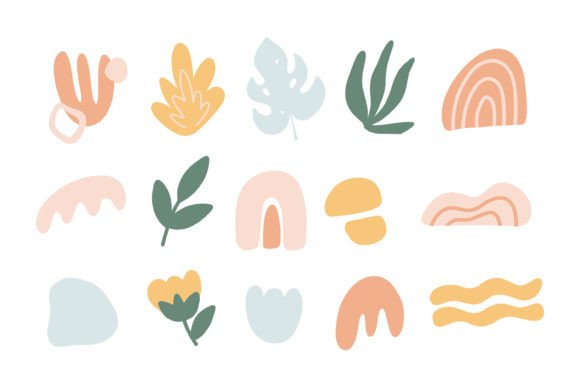
The moment I opened the folder, the mood was clear: gentle asymmetry, fluid edges, subtle weight shifts, and a sense of natural growth—not randomness. These aren’t chaotic blobs; they’re curated organic forms, with soft gradients implied through shape alone. They evoke watercolor blooms, pressed leaves, clay impressions, or slow-pour resin. That makes them ideal for brands rooted in wellness, sustainability, artisan craft, or slow-living aesthetics—think apothecaries, ceramic studios, indie perfume labels, or mindful parenting blogs.
Where It Shines in Real Client Work
In our tea launch, we used three of the PNG files as layered background elements behind product mockups—softly blurred at 15% opacity behind matte mug shots and flat-lay packaging photos. Instant warmth. Instant cohesion. No need for custom illustration from scratch.
- Product labels & packaging design: One large blob placed asymmetrically behind a minimalist label creates depth without competing with typography.
- Social media graphics: Scaled down to 30% size, they work beautifully as corner accents in Instagram carousels and Pinterest pins—especially when paired with serif or handwritten fonts.
- Printable design & editorial layouts: The 4000x4000 PNGs hold crisp detail even when scaled to full-page bleed in Canva templates or InDesign spreads—perfect for downloadable wall art or zine interiors.
- Cricut project & sublimation design: The SVG and EPS files scale infinitely for vinyl cutting or heat transfer—tested cleanly at 2" and 12" sizes on cotton tote mockups.
- Brand identity support: Not for logos—but excellent as pattern anchors, divider lines, or animated transitions in web design and email headers.
Where Caution Is Required
This isn’t a universal toolkit. Its strength is its softness—and that becomes a limitation in certain contexts:
- Small sizes: Below 150px width, detail blurs. Avoid using any blob as a favicon, app icon, or tiny sticker element without simplifying first.
- Crowded layouts: Place it near dense text blocks or photo collages, and it dissolves into noise. Give it breathing room—or use it as a full-bleed layer instead.
- Corporate or finance branding: Too lyrical for law firms, SaaS dashboards, or banking materials. It signals intuition, not authority.
- Minimalist or monochrome systems: On stark black-and-white backgrounds, some shapes lose contrast. Always test grayscale conversion—some rely on subtle tonal variation that vanishes in B&W.
How It Shapes Perception—Beyond Decoration
What surprises clients most is how much Organic Aesthetic Blob,abstract Shapes affects emotional resonance. In user testing for our tea campaign, audiences described visuals “feeling calm,” “handmade,” and “trustworthy”—not because of the copy, but because the blobs signaled care in composition. They subtly reinforce brand values: imperfection as intention, growth as process, texture as authenticity.
That said, it can weaken visual hierarchy if misapplied. Placed too close to body text or CTAs, it competes for attention. We solved this by using only one dominant blob per layout—and always anchoring it away from critical content zones. For logo design or core brand marks, skip it entirely. But as a graphic design asset that elevates supporting visuals? It delivers polish fast.
Designer Notes You’ll Actually Use
Before dropping this into a client file, run these checks:
- Test transparency: Drop each PNG onto light, dark, and midtone backgrounds—some edges feather slightly and may need manual cleanup in Photoshop if used on complex photos.
- Verify vector integrity: Open the AI and EPS files in Illustrator—check for stray points, ungrouped layers, or embedded raster effects. The SVG imported cleanly into Figma, but we simplified paths for Cricut Design Space compatibility.
- Contrast check: Run a luminosity test (in Photoshop’s Info panel) on key blobs against your brand’s primary background colors—aim for at least 4.5:1 for accessibility.
- Font pairing test: Try each blob with your client’s type system: it sings with serif and script fonts, holds its own with rounded sans serifs, but clashes with ultra-thin or geometric display fonts.
- Licensing confirmation: Yes—it includes commercial license. But double-check usage rights for print-on-demand platforms like Redbubble or Printful; some restrict third-party assets unless modified.
Final Verdict: A Thoughtful Decorative Element, Not a Shortcut
Organic Aesthetic Blob,abstract Shapes won’t replace custom illustration—but it will save 8–10 hours of ideation and iteration for the right small business branding project. It’s especially valuable for designers juggling multiple Etsy product listings, seasonal Canva template updates, or rapid-turnaround social campaigns where mood matters more than precision.
For creative marketplace sellers, it’s a smart addition to a design bundle—especially when paired with coordinating hand-lettering or botanical line art. For Cricut users and digital sellers, the SVG + high-res PNG combo covers both digital and physical outputs seamlessly. And for anyone building a handmade business or launching a boutique product line? It’s proof that thoughtful Decorative Elements don’t just fill space—they invite connection.