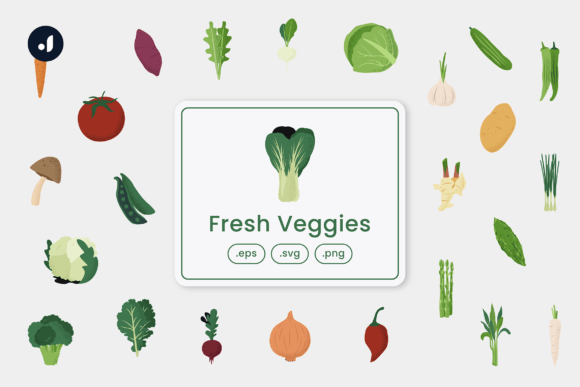
Fresh Veggies Illustration: Graphics & Decorative Elements
First Impression: Bright, Friendly, and Instantly Recognizable
When I opened Fresh Veggies Illustration, my first thought was: *This feels like sunshine on a farmers’ market stall.* The palette is vibrant but grounded—crisp greens, warm oranges, soft earthy purples—never oversaturated or cartoonish. It strikes a rare balance: playful enough for lifestyle brands and serious enough for health-conscious product launches. As a brand designer who’s reviewed hundreds of illustration packs, I immediately sensed its emotional tone: approachable, wholesome, and quietly confident. It doesn’t scream—it invites. That makes it ideal for small business branding, content marketing around wellness, seasonal offers (think “Spring Detox Kits” or “Farm-to-Table Meal Plans”), and digital product visuals where warmth and authenticity matter more than sleek minimalism.
Where Fresh Veggies Illustration Earns Its Place in Real Campaigns
Last month, I helped a plant-based snack startup refresh their social media graphics and email banners ahead of a summer product launch. We needed visual consistency across Instagram posts, Pinterest pins, and blog headers—without hiring an illustrator each time. Fresh Veggies Illustration became our secret weapon. Its fully editable vector files let us recolor individual carrots and kale leaves to match their brand’s sage-and-cream palette. We dropped them into Canva templates as decorative brand elements, used them as subtle background accents in email banners, and even adapted one beet illustration as a custom icon for their “Rooted Rewards” loyalty program.
It shines brightest in contexts that benefit from organic energy and visual breathing room: hero graphics for landing pages, packaging inserts for artisanal goods, branded templates for coaches launching nutrition challenges, and editorial layouts for food blogs or sustainability newsletters. On Pinterest, the illustrations scaled beautifully into vertical pins—clean lines held up even at thumbnail size. In printables? Perfect. We turned three veggies into a “Grow Your Own” checklist with hand-drawn typography—and it felt cohesive, not cluttered.
Marketing Goals This Graphic Design Asset Supports—Without Extra Work
- Stronger first impression: Replaces generic stock photos with distinctive, ownable visuals that signal care and craft.
- Clearer visual hierarchy: Its generous negative space lets headlines and CTAs stand out—no competing detail overload.
- More consistent branding: As a design bundle, it delivers stylistic continuity across touchpoints without needing custom illustration every time.
- Better product presentation: When layered behind product shots (e.g., on packaging mockups), it adds context—not distraction.
- Improved audience trust: Human-crafted, non-AI-looking illustrations subconsciously signal authenticity to conscious consumers.
- Stronger recognition: Repeating a signature veggie motif (like that stylized radish) builds visual shorthand across campaigns.
Where It Works Best—And Where to Pause
Fresh Veggies Illustration excels as a decorative brand element in hero sections, campaign headers, social media covers, and content bundles. It’s ideal for printable promotions, event flyers (think farmers’ market booths or wellness fairs), and merchandise like reusable produce bags or recipe cards. As SVG design or PNG design, it scales flawlessly—from website headers down to sticker sheets.
Use carefully in formal corporate branding, dense infographics, or text-heavy Facebook ads where clarity trumps charm. Avoid placing it over low-contrast backgrounds (e.g., light green on mint), and don’t force it into ultra-minimalist brands that rely on stark geometry and monochrome palettes. If your main message needs absolute dominance—like a limited-time discount code—let the illustration play supporting role, not center stage.
Practical Brand Designer Notes You’ll Actually Use
Before dropping Fresh Veggies Illustration into production, I always run these checks:
- Test it against your full brand color palette—not just primary, but secondary and neutrals—to ensure harmony.
- Convert to grayscale: Does the contrast hold? Will it work in black-and-white print or embroidery?
- Drop it into real campaign mockups—website headers, Instagram Stories, email templates—to assess balance and spacing.
- Preview on mobile: Does the detail read at 30% scale? (Spoiler: Yes—the clean linework holds up.)
- Compare side-by-side with top competitor visuals: Does it feel distinct, not derivative?
- Pair it with your fonts: It complements serif fonts for editorial elegance, sans serifs for modern clarity, and script fonts for handmade charm—but can overwhelm heavy display fonts.
- Verify commercial license: This isn’t clipart for hobby use. Confirm it’s cleared for client work, paid ads, and digital product resale before building a Canva template or lead magnet around it.
Why Creative Entrepreneurs Keep Coming Back to This Kind of Design Asset
In today’s saturated feed, professional branding isn’t about perfection—it’s about resonance. Fresh Veggies Illustration delivers that resonance without demanding perfectionism. It’s a modern design tool built for speed, flexibility, and emotional intelligence. Whether you’re a blogger curating a seasonal content kit, a small business owner designing packaging accents, or a digital seller bundling printable designs, this graphic design asset bridges the gap between “handmade heart” and “commercial-ready polish.” It supports visual hierarchy instead of fighting it. It builds audience trust by feeling human-made, not algorithm-generated. And because it’s fully editable and scalable vector Files compatible with Adobe Illustrator and Adobe Photoshop, it grows with your brand—not against it.
For marketers who know visuals are the first sentence of every story they tell, Fresh Veggies Illustration isn’t just decoration. It’s strategic communication—delivered with roots, freshness, and quiet confidence.