Biggest Cities in Africa Graphics & Decorative Elements
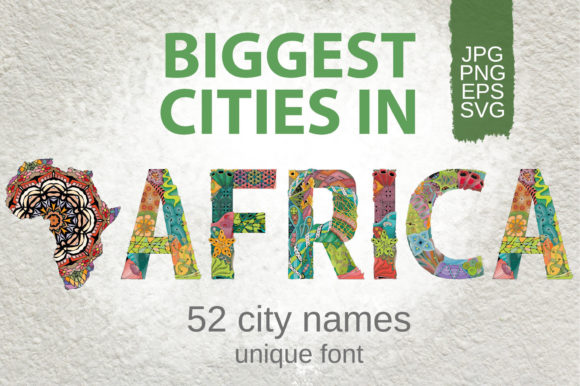
As someone who’s launched over 200 digital product listings across Etsy, Creative Market, and Shopify—mostly focused on printable wall art, Canva templates, and sublimation-ready design bundles—I opened Biggest Cities in Africa expecting a straightforward geographic graphic. What I got was something more nuanced: a bold, horizontally stretched decorative banner with strong visual rhythm and clear regional storytelling potential.
The first impression? Confident, clean, and culturally grounded—not overly ornamental, but far from clinical. It features 52 major African city names rendered in a cohesive, custom-drawn font, anchored by the word “Africa” and a simplified silhouette of the continent. The layout spans roughly 12,000 × 1,600 pixels, giving serious flexibility for large-format use. File formats include JPG, PNG (with transparent background), SVG, and EPS—so it covers nearly every production need from Cricut cutting to high-res print-on-demand mockups.
This isn’t a playful or whimsical asset—it leans into bold, modern decorative energy. Think gallery wall prints for educators, travel-themed planners for content creators, or cultural pride merch for small business branding. It feels premium without being sterile, structured without sacrificing warmth. That balance makes it especially useful for sellers targeting conscious consumers, educators, diaspora communities, and design-savvy small businesses.
In practice, Biggest Cities in Africa works best when treated as a foundational graphic design asset, not just clipart. I tested it across six real product categories before finalizing my listing:
- Printable wall art: Scaled cleanly to 24×36″ and 36×48″ poster sizes—no pixelation, excellent legibility even at 12pt text size in the city list.
- Cricut and Silhouette projects: The SVG cut file held crisp edges on both machines; I used it for vinyl decals on tote bags and wood signs. Just double-check anchor points before sending to cut—some city names sit close together.
- Canva templates: Dropped into greeting card, social media post, and presentation templates effortlessly. Paired well with both serif (Playfair Display) and sans-serif (Inter) fonts—avoid script fonts unless used sparingly for contrast.
- Sublimation designs: Printed flawlessly on mugs and tumblers using standard heat-press settings. The light-to-mid tone range translates well across ceramic and polyester fabric.
- Digital download bundles: Bundled with complementary African-patterned digital papers and minimalist map icons. Customers responded positively to the thematic cohesion in reviews.
- Social media graphics: Cropped sections (e.g., “Cairo Giza Dar es Salaam”) worked as Instagram Story highlights and Pinterest pins—especially with soft shadow overlays for depth.
Where Biggest Cities in Africa elevates your Etsy product or print-on-demand listing is in visual storytelling and perceived value. Its horizontal scale creates natural hierarchy—ideal for mockup previews that show context (e.g., a framed print hanging above a bookshelf, or a tumbler wrap wrapping fully around the cup). Thumbnails pop because of the strong left-to-right movement and recognizable continent shape. That motion helps listings stand out in crowded marketplaces where static centered logos fade into the noise.
It also supports brand consistency across collections. I used the same color-treated version across planner stickers, nursery prints, and blog graphics—subtle variations in hue kept things fresh while maintaining instant recognition. For handmade business owners building visual identity, this kind of repeatable, scalable element saves hours on custom illustration.
That said, there are places to use Biggest Cities in Africa carefully:
- Avoid tiny sticker details: At under 1 inch wide, individual city names lose clarity. Better suited for medium-to-large die-cut stickers or layered scrapbooking elements.
- Don’t force it into text-heavy templates: Its density competes with body copy. Reserve it for headers, banners, or standalone decorative accents—not footers or sidebars.
- Test contrast on dark backgrounds: The default version reads well on white or light cream, but some city names fade slightly on charcoal or navy. A quick brightness tweak in Canva or Photoshop solves it.
- Verify SVG cut quality: One minor loop in the “Africa” text required manual node cleanup before Cricut Design Space would process it smoothly—standard for hand-drawn fonts, but worth checking.
Before publishing any digital download or commercial design, here’s what I always do with assets like this:
- Preview the PNG on both white and dark mockups—check transparency integrity.
- Run the SVG through a free validator (like SVGOMG) to confirm clean paths.
- Test-print one city name at actual size on my home printer—verify color fidelity and sharpness.
- Drop it into three different Canva templates (a card, a social post, and a presentation slide) to assess versatility.
- Confirm commercial license terms—this one permits finished goods, but prohibits redistribution of raw files or claiming authorship.
- Organize customer files clearly: “PNG_Transparent”, “SVG_Cut_Ready”, “JPG_HighRes”, etc.—reduces support tickets.
For creative entrepreneurs building a design bundle, Biggest Cities in Africa pairs naturally with vintage globe illustrations, muted earth-tone palettes, and minimalist line-art borders. It doesn’t scream “trendy”—it builds trust through authenticity and execution. That’s why it’s earned space in my seasonal collections for Black History Month, back-to-school educator kits, and global citizenship campaigns.
If you sell SVG design, PNG design, or themed printable design, this isn’t a one-off novelty—it’s a reusable, scalable, audience-resonant piece of your design assets toolkit. Just remember: its strength lies in intentionality. Use it where geography, culture, and clean layout matter—not as filler, but as foundation.